http://oceanservice.noaa.gov/news/features/nov09/nwhimd.html
Removing Marine Debris for the "Dogs that Run in the Rough Sea"
NOAA Gathers, and Recycles, Tons of Trash from Hawaii’s Papahānaumokuākea Marine National Monument
On two separate missions in September and October, the NOAA Ship
Oscar Elton Sette set sail from Honolulu, Hawaii, to scour, somewhat literally, portions of the vast and remote Northwestern Hawaiian Islands (NWHI). The NWHI comprises nearly 140,000 square miles (362,600 square kilometers), and in June 2006, a Presidential proclamation designated the area as the Papahānaumokuākea Marine National Monument, the single largest conservation area under the U.S. flag, and one of the largest marine conservation areas in the world.
The ship and its crew, which included 17 specially trained divers from NOAA’s Pacific Islands Fisheries Science Center and the University of Hawaii’s Joint Institute for Marine and Atmospheric Research, traveled out there to pick up trash. Tons of trash, actually, much of it derelict commercial fishing gear.
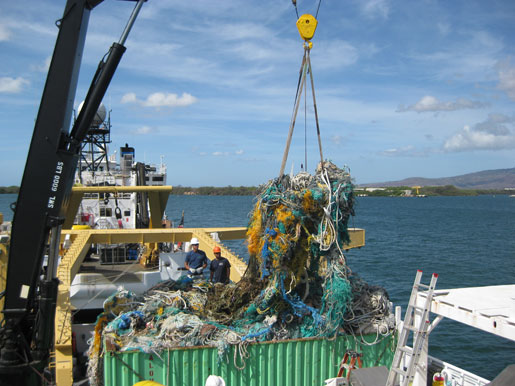
The NOAA Ship
Sette unloads its undesirable "catch."
A Cluttered Convergence Zone
The cleanup is part of an ongoing project among NOAA, the U.S. Coast Guard, and other public and private partners to remove marine debris in the NWHI, where the highly endangered Hawaiian monk seal roams. The native Hawaiian name for the species is
Ilio-holo-i-ka-uaua, which translates to “the dogs that run in the rough sea.” Scientists believe that only about 1,200 individual Hawaiian monk seals remain in the wild.
The seals’ habitat within the National Monument lies somewhat south of the North Pacific Subtropical Convergence Zone, an area where huge piles of floating
marine debris tend to concentrate, which is why NOAA has been working to clean up the area for more than a decade. This zone is one of many that concentrate marine debris. Another such area is the so-called “
Great Pacific Garbage Patch.”
‘Deep’ Cleaning
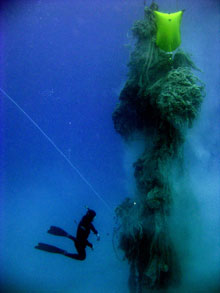
A specially trained NOAA diver confronts an enormous floating mass of marine debris, comprised mostly of derelict commercial fishing gear.
Even though Hawaii itself has no commercial fishery that allows for the use of nets, the dive team from the
Sette gathered mostly large, cast-off trawl and seine nets, net fragments, monofilament fishing lines, ropes, floats, and other gear. Nearby beaches accumulate plastics, glass bottles, metal, Styrofoam, light bulbs, cathode-ray tubes, and other byproducts of human life and industry.
These destructive dregs pose serious entanglement hazards to the monk seals and other marine life, such as the threatened green sea turtle. They also impede navigation, foul the area’s shallow-water coral reefs, and may serve as floating transports for invasive species, all of which lead to habitat degradation.
The free divers remove the debris by hand and are extremely careful when they must lift it off of, or cut it away from, the sensitive coral structures and other substrate below the water surface. Lift bags are sometimes used to float large bundles of net to the surface. The debris is placed in an Avon inflatable-hull boat, then gathered up by a crane on the
Sette and placed in a 20-foot-square container on board. When the container fills up, the excess is stored on deck in a roped-off "corral” and in cargo nets.
The Growing Pacific ‘Recycle Bin’: Nets to Energy
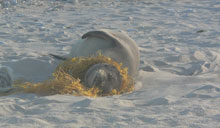
An endangered Hawaiian monk seal succumbs to the scourge of marine debris in the Papahānaumokuākea Marine National Monument.
Since 2002, nearly 700 tons of marine debris removed from the NWHI has been “recycled” into electricity as part of the nation’s first Nets to Energy Program. The recent NOAA missions transported more than 66 tons of ocean-fouling muck to Schnitzer Steel Hawaii Corporation, where it will be cut into 18-inch (0.5-meter) chunks ready for combustion at the City and County of Honolulu’s HPower waste-to-energy facility, run by Covanta Energy.
This unique partnership, which involves more than a dozen public and private entities, has, to date, created enough energy to power 245 Hawaii homes for a year. Not such a bad use of a bad thing, perhaps, but NOAA’s ultimate goal is to halt the constant barrage of garbage from entering the ocean in the first place. This will require greater public understanding of, and better ways of preventing, the toll our blue planet pays for an ongoing ethos of waste.



 Posts
Posts